
Time travel has interested us for generations & inspired countless stories. However, it may not just be a work of fiction. There are some real scientific theories that suggest that traveling through time might actually be possible! Here are eleven theories that could make time travel a reality. Who knows what the future (or past) has in store for us?
Featured Image Credit: prometeus /Depositphotos.com.
Einstein’s Theory of General Relativity

Einstein’s general relativity tells us that mass warps spacetime and that massive objects like stars & black holes don’t just pull things with gravity. Instead, they actually bend the fabric of space and time around them. Such warping creates loops called closed timelike curves. If someone could get one of these loops around a massive object, they could arrive at an earlier point in time.
Time Dilation in Special Relativity

Einstein’s special relativity shows that time moves slower for objects traveling close to the speed of light. As a result, astronauts on a high-speed journey would age less than people on Earth—they might travel for what felt like ten years to them, yet decades or even centuries might’ve passed on Earth. We already know time dilation is real. But maybe in the future, we could use it to move into the future.
Like our content? Be sure to follow us.
Wormholes as Time Tunnels
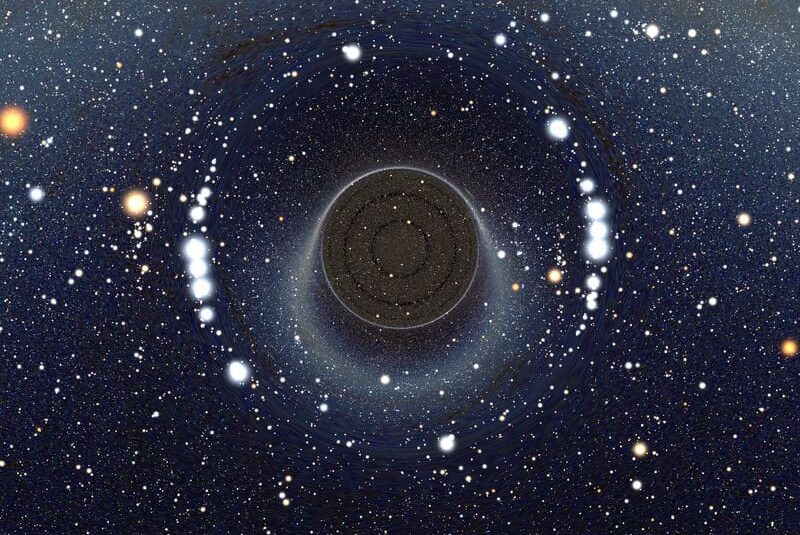
Wormholes are theoretical tunnels that connect distant points in spacetime. If we find or create one, we could accelerate one end to near the speed of light before bringing it back—and so, time would pass differently at each end. It’s all thanks to time dilation! Entering the stationary end would allow you to exit the other end at an earlier time so you effectively travel into the past. However, we haven’t found wormholes & we don’t even know how to manipulate them.
Cosmic Strings
Cosmic strings are hypothetical defects in spacetime that may have formed in the early universe. They’re incredibly thin but carry immense mass which allows them to warp spacetime around them. When two cosmic strings pass by each other at high speed (or if one moved quickly), the gravitational effects might be strong enough to create time loops. As such, it’d allow for travel back in time.
The Tipler Cylinder

Time to look at a theoretical machine—the Tipler Cylinder, to be specific. It’s a massive cylinder that rotates along its length at incredibly high speeds and if this cylinder were infinitely long & spun fast enough, it could twist spacetime around it. A spaceship following a precise spiral path around the cylinder might travel backward in time. Unfortunately, building such a cylinder isn’t possible with our current technology—and the infinite length is another problem!
Tachyons and Faster-Than-Light Travel
In theory, tachyons are particles that always move faster than light and Einstein’s ideas suggest that faster-than-light travel could involve going back in time. We don’t know if tachyons exist. If they do, they might be able to carry information—or even matter—into the past. Even though we have no evidence for them, just the possibility of them existing opens up interesting possibilities for time travel.
Quantum Tunneling

In quantum mechanics, particles sometimes pass through barriers instantly in a process called quantum tunneling. It completely defies classical physics! In fact, such a theory suggests particles may exist in multiple places or states simultaneously. Some scientists believe that quantum tunneling involves particles moving between different points in time, creating a quantum basis for time travel. Of course, it’s all still theoretical.
Gödel’s Rotating Universe
Mathematician Kurt Gödel apparently found a solution to Einstein’s equations that describes a rotating universe. In his model, curving spacetime allows you to travel through it and go back to an earlier time. Sadly, our universe doesn’t seem to rotate like this. Yet Gödel’s solution shows that time travel could work with the laws of general relativity!
Negative Energy and the Alcubierre Drive

As part of the Alcubierre Drive, we could compress space in front of a spacecraft & expand it behind. In doing so, the ship would move faster than light relative to distant objects without locally breaking the speed of light. However, the drive would need negative energy to warp spacetime. Just where would we find that?!
Quantum Entanglement and Retrocausality

Quantum entanglement links particles so that the state of one instantly affects the state of another—no matter the distance between them. Some interpretations suggest this connection could work backward in time as part of a theory called retrocausality. Simply put, it involves the effects coming before their causes at the quantum level. If this were true, it may be possible for information—or even particles—to travel back in time.
Multiverse and Parallel Universes

The multiverse theory suggests that our universe is just one of many parallel universes existing simultaneously including those on different timelines. As such, traveling between them would give us access to events in another universe’s past or future. We could travel to a universe where the Big Bang happened later. In doing so, we might be able to see the Earth as it was billions of years ago—including the dinosaurs!
Disclaimer: This list is solely the author’s opinion based on research and publicly available information.
Like our content? Be sure to follow us.
Read More: