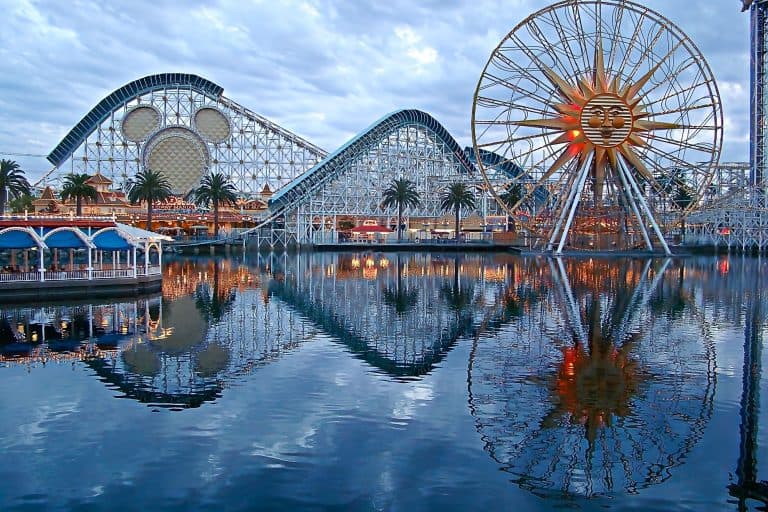

You’d think everything went well when Disneyland opened its gates on July 17, 1955. But, behind the scenes, it was total mayhem & it actually looked like the park might not make it through that first year. What went so wrong during its first year? Let’s see what happened.
Featured Image Credit: Shutterstock.
Key takeaways

You’ll find out about:
- The breakneck build on empty groves
- The creative financing that kept construction alive
- Why opening day went off the rails
- What changed to keep crowds coming
A one-year build on former orange groves

In 1954, Anaheim was just rows of orange trees baking in the California sun. Then the bulldozers rolled in & Disneyland sprouted almost overnight. They started digging on July 16, 1954, and by July 17 the next year, people had begun lining up to walk through the castle.
The bill came out to around $17 million, or around $205 million in today’s money. These costs came from custom rides & landscaping, as well as last-minute fixes. Walt pushed everything forward so quickly that overruns were constant. Unfortunately, there wasn’t any cushion, and every delay meant scrambling to keep the whole thing afloat.
How the ABC deal kept the project moving

Cash flow was a nightmare. After all, banks weren’t exactly lining up to fund a “theme park” because it was essentially a brand-new idea back then. Disney struck a deal with ABC-Paramount, who chipped in roughly a third of the cost & received TV rights in return. It’s likely the park’s opening would’ve stalled out halfway through construction without that deal.
To make sure people actually cared when the park opened, Disney launched a weekly show on ABC in October 1954. Each episode teased bits of the park & built hype across the country. By the time the gates opened, kids already felt like they’d been there. Essentially, the show worked like a year-long commercial & it did the job.
What actually went wrong on “Black Sunday”

Opening day was supposed to be invite-only for 15,000 people. However, it didn’t work out that way. Counterfeit tickets flooded in & the crowd swelled far past what the park could handle.
Since it was over 100°F, the asphalt softened under the sun, and women’s heels stuck to the floor. Drinking fountains were also dry, thanks to a plumbers’ strike, while rides kept breaking down. Worse still, there was a gas leak that shut down parts of Fantasyland for hours.
All in all, it wasn’t a magical experience & far from what most people were expecting.
Operational growing pains

Disneyland’s first few months were rough. After opening day, the rides started breaking down way too often because crews were still learning what could hold up under full crowds. A lot of the machinery just wasn’t built for that kind of nonstop use yet. As such, mechanics stayed overnight to swap parts and do whatever it took to get things running again by morning.
However, some attractions couldn’t keep up at all. A few went dark for weeks while engineers tore into them to find better fixes, including Canal Boats of the World. It opened & suffered through short runs, then shut down not long after. It didn’t come back until mid-1956. By then, it was reworked into the Storybook Land Canal Boats, with new details & more reliable systems.
Staffing problems

Sadly, the human side of the park didn’t run well either. Most early employees had never worked in a place like this, since a theme park wasn’t really a thing yet. Jobs changed constantly & people weren’t sure who handled what. Some employees came from retail. Others were from hospitality. And a lot of them were college kids hired for the summer. Altogether, the mix made for long shifts & quick burnout.
Training was also all over the place in the beginning. Supervisors were stretched thin, trying to make sure everyone stayed consistent while still learning the ropes themselves. Over time, Disney tightened things up by setting roles & standardized training. They eventually built a system that actually prepared new hires.
It took months. But once that structure began, turnover started dropping & things got steadier.
Traffic and parking issues

Getting to Disneyland was almost as difficult as being inside it. After all, Anaheim’s roads weren’t built for thousands of cars rolling in every morning. The Santa Ana Freeway helped people reach the area. But once they got close, traffic slowed to a crawl & locals complained about endless lines.
City officials scrambled to adjust stoplights & add signage. Disney’s own planners kept tinkering with parking flow. The company started coordinating more directly with local authorities to build better access roads & widen important routes near Harbor Boulevard. Soon enough, the worst of the gridlock started to ease once the changes rolled out.
By the following summer, getting in and out wasn’t painless. But it finally stopped being a total traffic disaster.
How admission and rides were priced that first season

The entry fee was just $1 for adults. However, that simply got you through the gate and nothing more, as rides cost extra & were sold in ticket booklets divided into tiers. A-tickets were for the simple rides, while C-tickets were the “big” ones.
As a result, families had to ration tickets carefully, which made the park feel more like a fair than the modern, all-inclusive park we have come to know.
Financial tightrope

While the cheap admission price brought people in, it didn’t cover much once all the bills came due. Guests spent only a few dollars on food & souvenirs. That didn’t stretch far when the park had a full-time maintenance crew and debt from construction, as well as payroll, running daily.
To make it work, Disney leaned hard into anything that could bring in steady cash. Souvenirs took off fast, like maps & character hats. The Davy Crockett craze also exploded that year. As such, sales of coonskin caps and related items helped fill the gap.
The leased-out food & shop model
That’s not all. When Disneyland opened, a lot of the places to grab a snack or buy something weren’t actually run by Disney. They were handled by outside companies that signed lease agreements to set up inside the park. Yes, this decision saved money upfront & helped fill the space quickly. But it caused plenty of issues once crowds showed up.
Main Street had sponsor-run restaurants & Frontierland had branded shops. Some stands were basically small franchise deals. Each company had its own staff, supplies, and schedules, so it was effectively a bunch of disconnected teams working side by side.
Whenever a food counter ran out of something, Disney managers couldn’t just step in to fix it, nor could the stall borrow from the place next door. Technically, that was another business’s inventory. Instead, they had to call the partner. And wait.
The delivery & pricing problem

Deliveries were a logistical mess because each company ordered ingredients separately. As such, trucks came in from different suppliers on their own schedules. Those little stalls didn’t have much storage space either, so shortages happened faster than anyone expected.
Pricing was a challenge, too, since some menus were tied to sponsor guidelines, not Disney’s. Adjusting prices during busy weekends wasn’t easy when everything had to be cleared with the lessee. Even simple changes, like switching to a bigger cup or adding more seating, required conversations with companies outside the park.
The live broadcast that magnified every hiccup
ABC aired the grand opening live on national TV. At the time, it was their biggest remote broadcast ever, with millions of people watching celebrities & reporters sweat through the chaos. The cameras caught the traffic jams and the broken rides.
Yet people still came. By the end of 1955, more than two million visitors had walked through the gates, and that number jumped to around 5.6 million towards the end of 1956. Somehow, curiosity won out over the bad press of the messy launch.
Television carried a lot of the load, too. Millions tuned in weekly to the Disneyland show on ABC, which kept people talking about the park even if they hadn’t visited yet. The exposure meant families started planning trips months ahead. It kept the idea of Disneyland in front of a national audience without big advertising costs.
What the park added within the first year
To keep up with the flood of guests, Disneyland upgraded quickly. Bigger rides went in & lines were reorganized, while food and drink areas multiplied. Soon enough, the park could handle way more people, and spending inside the gates was already climbing. It wasn’t fancy yet. But it was working.
Sources: Please see here for a complete listing of all sources that were consulted in the preparation of this article.
Like our content? Be sure to follow us.


