

At several points in history, mankind has narrowly avoided terrifying catastrophes, often while most of society was completely unaware of how dire the situation had become.
One man said no
On September 26, 1983, Soviet officer Stanislav Petrov was monitoring an early-warning system when it alerted him that the United States had launched a nuclear missile strike on the Soviet Union. The system then detected several more missiles.
Petrov suspected a malfunction: An actual first strike from the United States would likely involve far more missiles than this. He reported a false alarm instead of reporting enemy activity and possible nuclear retaliation. He was correct. Satellites had detected sunlight reflecting off high-altitude clouds and interpreted it as missiles.
Beneath the waves
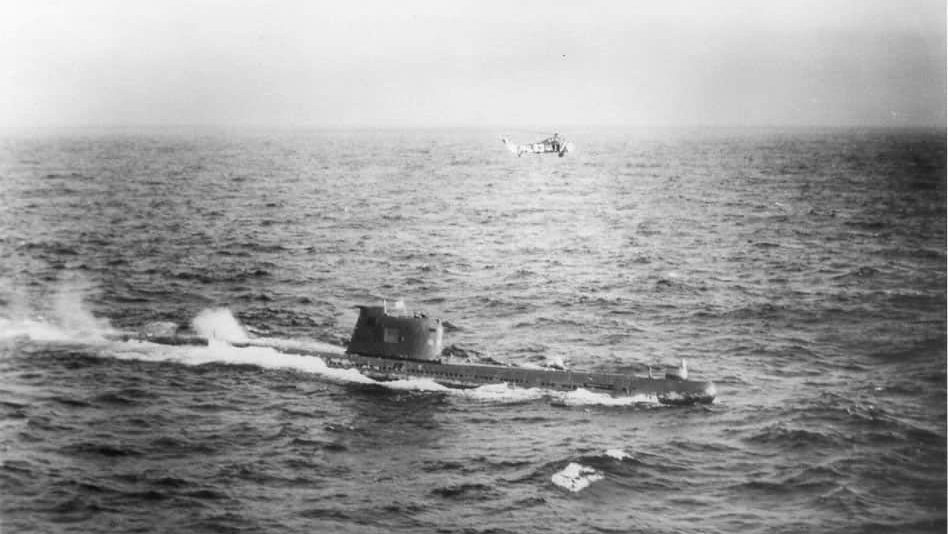
In October 1962, during the Cuban Missile Crisis, American forces began dropping signal depth charges near Soviet submarine B-59 to force it to surface. The crew aboard B-59 lost contact with Moscow and was unaware if a war had already started. There were nuclear torpedoes on board B-59, and Captain Valentin Savitsky reportedly wanted to ready one of them for use.
However, B-59’s senior officer Vasily Arkhipov disagreed with launching the nuclear torpedo. B-59 surfaced instead. If one of the nuclear torpedoes had been fired at the U.S. in the middle of the Cuban Missile Crisis, the results would have been catastrophic.
The wrong tape

On November 9, 1979, NORAD’s computers mistakenly warned of a large-scale Soviet nuclear attack. Although the United States took the warning seriously and quickly scrambled interceptor jets and put its nuclear forces on alert for a potential retaliatory response, no evidence of actual Soviet missiles could be found by other warning systems.
It was later found that a training exercise depicting a Soviet attack had been mistakenly inserted into an operational warning system. Although the false alarm lasted only a few minutes, during that time U. S. military planners thought that nuclear war may have started.
A chip worth less than a dollar

On June 3, 1980, another harrowing false alarm happened in the United States. Alerts showed that Soviet missiles had been launched. However, as the numbers increased to several hundred inbound missiles, they would suddenly reset back to zero. Strategic forces were placed on alert, and high-level officials began verifying other detection platforms were working properly.
The attack wasn’t real. Researchers later determined the cause to be a faulty computer chip used in a communications equipment system. A microscopic circuit had nearly caused alerts of a situation that could have initiated a response that affected millions of people.
The rocket Russia didn’t expect

On January 25, 1995, Norway launched a research rocket to study the northern lights. Russia had been notified of the launch, but that knowledge evidently did not filter down to some of Russia’s military commanders. Russian radar operators tracked the rocket and became concerned that it might be a U. S. submarine-launched missile aimed at disabling Russian defenses in preparation for a bigger attack.
President Boris Yeltsin had the Russian nuclear command briefcase brought to him and activated while officials tracked the rocket. It quickly became apparent that the rocket could not be a threat, and the alarm was canceled.
A solar storm aimed elsewhere

Back in July of 2012, the Sun unleashed one of the largest coronal mass ejections ever recorded, which passed through Earth’s orbit. Luckily for us, Earth happened not to be in its path when it got there. NASA scientists determined that had the eruption happened just a week earlier, Earth would have been in the direct line of fire.
A solar storm of that size could knock out power grids, satellites, communications, and other technology. It wouldn’t have obliterated Earth or ended civilization as we know it, but it would have caused massive damage.
The asteroid we noticed afterward

The asteroid designated 2002 MN passed very close to Earth on June 14, 2002, just about 120000 kilometers away, less than one-third of the distance to the Moon.
Worse still, astronomers didn’t find it until after it had already passed by Earth. Although it was only about tens of meters in size, if 2002 MN had hit Earth, it still would have released a significant amount of energy and caused damage.
The sky caught fire

On September 1859, the Carrington Event, the most powerful geomagnetic storm on record based on direct observation, occurred. Following a strong solar flare, auroras were visible much closer to the equator than normal and were said to be bright enough to read by at night in some areas. Telegraph operators felt electric shocks, equipment malfunctioned, sparks flew from telegraph wires, and some stations reportedly caught fire.
Today, a storm of similar magnitude could cause disruptions to satellites, GPS, radio communications, and electric power grids, resulting in widespread expensive outages.
A mysterious swarm
In August 1883, Mexican astronomer José Bonilla announced that he had seen hundreds of dark objects transit the face of the Sun as seen from the Zacatecas Observatory, and had photographed some of them.
More than 100 years later, it was suggested that Bonilla may have observed fragments of a very large comet that had broken up and passed extremely close to Earth. In this scenario, the comet fragments passed only thousands of kilometers above the surface of Earth, and impacts by hundreds of large fragments could have caused a global catastrophe.
One dropped socket

In September 1980, while changing out a valve on a tank of explosive fuel inside a Titan II missile silo near Damascus, Arkansas, a technician accidentally dropped a heavy socket wrench. The wrench fell approximately 80 feet before bouncing and punching a hole in the missile’s pressurized fuel tank.
Hours later, leaking fuel helped cause an explosion that destroyed the silo. The explosion killed one serviceman, injured several others, and launched the missile’s W53 nuclear warhead out of the silo. The warhead had an estimated yield of approximately 9 megatons of TNT. Luckily, the device failed to detonate because the warhead’s safety systems were still intact.
Sources: Please see here for a complete listing of all sources that were consulted in the preparation of this article.
Like our content? Be sure to follow us.

