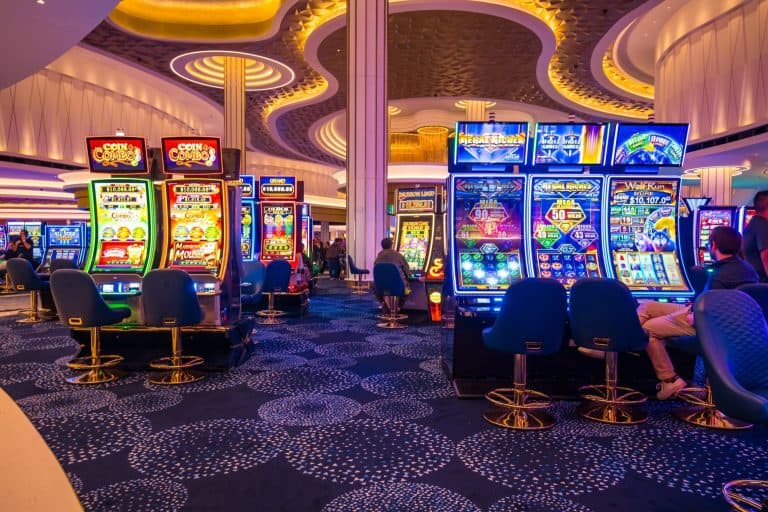

Carpets. Most people don’t think about them, yet there’s a lot that goes into designing them & especially in casinos. You may have noticed that casino carpets are pretty ugly. That’s on purpose. Every detail, including the repeating pattern & blend of fibers, is thought out.
Why do they do this? Why do they make it so ugly? Here are the reasons why.
Featured Image Credit: Shutterstock.
Key takeaways
You’ll find out about:
- How Axminster looms create these patterns
- Why they choose these patterns
- Who actually designs the carpets & how they test them
- How light & even sound affect design
What makes the patterns look “loud”

Most casinos use Axminster-woven carpets, which use a type of loom that only allows patterns to repeat in certain sizes. All the designs have to fit inside that frame. As such, most of the fine details get lost, so designers go big with bold swirls & oversized motifs. They also use lots of contrast because it’ll look better than anything that’s too faded.
The pile density is usually around 45–63 tufts per square inch. That’s rather chunky compared to rugs you’d see at home. But to keep it from looking flat or blocky, designers use shading tricks that create a sense of depth, so from far away, the carpet looks like different layers on top of each other.
That’s usually what makes them look ugly. They’re busy & quite loud, although the goal isn’t exactly to make art. Really, the designers just want to make floors that stay presentable for years in a punishing environment.
Why “busy” helps in high-traffic spaces
Casino floors take a beating. Just think about it. Thousands of people, along with their drinks & snacks. Don’t forget all the dirt from their shoes. A plain beige carpet wouldn’t last a week without looking trashed, while busy patterns with different colors disguise stains & wear almost like an optical illusion.
Mid-range tones blended together hide tracked-in dirt better than big blocks of solid color. Essentially, the more going on visually, the less your eye latches onto one spill or one scuff.
How the design process works
First comes the repeat. Since Axminster looms can only weave in set widths, designers have to make sure patterns line up at the seams without looking chopped. The next step is the color palette & they usually stick with middle values. They’re not too dark & not too light, just in the middle.
Another trick is “optical mixing.” This involves lots of tiny dots of different colors blending when you look at them from a distance.
After that, the mill weaves test samples & checks them under actual casino lighting. Then they’re finally approved.
What they’re made of (and why)

Most of the time, casino carpets are made from an 80/20 wool-nylon blend because wool dyes well & springs back after compression. The nylon makes it stronger, so the pile doesn’t crush as quickly.
In fact, research shows that such a mix often outperforms many synthetic-only carpets in terms of how long it looks good. Some places do still use pure wool. But the blend is more common in casinos because it’s a good balance of cost and performance.
Why lighting and sound matter
The colors of the carpet change depending on the bulbs overhead. As such, a carpet that looks deep red under fluorescent light might look more orange under warm incandescent bulbs. Designers have to account for this. That’s especially true in casinos where the lighting may be mixed.
Beyond the looks, though, carpet is also one of the easiest ways to soften noise in a space full of chatter & machines. Acoustic studies show that pile carpets absorb mid to high frequencies quite well. As a result, they’re rather useful in gaming halls. If they used hard flooring, the sound would bounce everywhere.
Fire safety rules casinos have to follow

Another important thing to remember is that casinos can’t just throw down any carpet they like. Those floors have to pass fire tests before they ever hit the gaming floor & the main rules in the U.S. come from the Flammable Fabrics Act. This states that carpets can’t catch fire too easily.
To check that, samples go through what’s called the “pill test,” which is exactly what it sounds like. It involves placing a small burning tablet on the carpet swatch. If the flame spreads, it fails. They do this test eight times & at least seven of them have to hold up, or else the carpet can’t be used.
However, most casinos go beyond the basic pill test by checking them using radiant panel tests, too. These measure how the flooring behaves when it has been exposed to a larger flame source. As you might expect, that’s especially important in places with such huge crowds.
Making choices
Most of the time, the design choices boil down to a few factors. These include:
- The illusion of depth to make scuffs less noticeable
- Use of bold shapes to read clearly at Axminster density
- Using mid-value colors to hide dirt better than pale or dark solids
- Engineering repeats to flow across huge rooms without seams showing
A note on the wider environment

One thing to remember is that carpet is only one part of the bigger setting. Casinos do a lot of research into “atmospherics,” which involves looking at all sorts of things, including ceiling height & employee uniforms.
The floors are just one piece of the larger design puzzle. But they’re a visible one. And one that’s impossible to miss when the pattern’s practically shouting at you.
Sources: Please see here for a complete listing of all sources that were consulted in the preparation of this article.
Like our content? Be sure to follow us.

