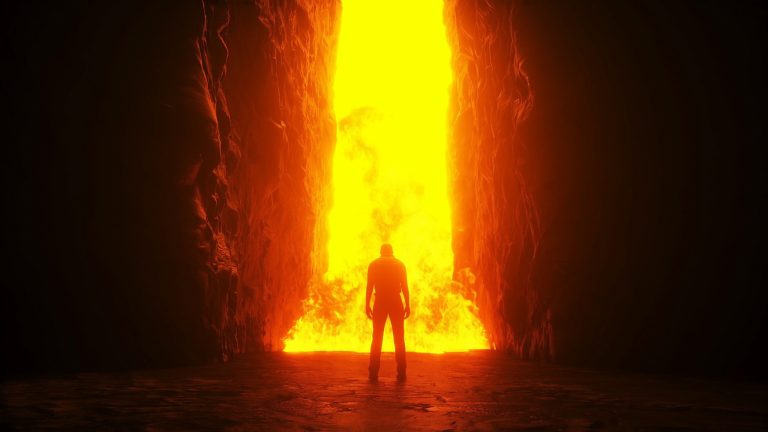

Key ideas Jesus shared about hell, including fire, darkness, judgment, and consequences.
He said body and soul were both involved

Matthew 10:28 includes a very specific statement from Jesus where he talks about both parts of a person, saying that his listeners shouldn’t fear anyone who can only kill the body.
No, instead, people should fear the person who can destroy both a person’s body and soul in hell.
He also warned believers about the person who truly holds authority over the final judgment. It’s not anyone on earth.
As such, it appears that hell is as much a place of physical punishment as it is spiritual punishment, so we should be wary of that fact.
He described hell with fire that is not quenched

Sure, you probably know that hell is a place with a lot of fire. But you may not know about the rather vivid language that Jesus used to talk about it, including in Mark 9:43-48, where he spoke about it as being a place of unquenchable fire.
In other words, it’s a place where the fire never goes out.
He also spoke about it being somewhere where ‘the worm does not die.’
Interestingly, the line is rather similar to some of the language used in Isaiah 66:24, and He goes on to repeat the warning about fire while also mentioning parts of the body. We’ll talk about that in a little more detail later.
He said the eternal fire was prepared for the devil and his angels

Speaking of fire, Jesus adds more details to it in Matthew 25:41 by describing hell as an eternal fire. But he said that this fire was prepared for the devil and his angels, although he does mention that some people will be told to depart there during the final judgment.
Jesus also mentions in this scene how people will be identified in terms of how they treated the hungry and the stranger, as well as the prisoner. He shares these ideas directly before the assembled nations.
He also spoke about darkness

Despite what some people might believe, Jesus painted more pictures of hell than merely fire. He described it as a place called ‘outer darkness’ in Matthew 8:12 and Matthew 22:13, later going on to mention it as being somewhere with ‘weeping and gnashing of teeth.’
It’s an image that appears quite often during the Gospel of Matthew while Jesus talks about judgment.
Later, in Matthew 25:30, He uses the same wording again when teaching about final judgment and the idea of exclusion. The image of constant darkness seems to be as important to His descriptions of hell as the classic image of fire.
He said judgment would not be the same for everyone

The idea of judgment is different for each person, too.
In Matthew 11:22-24, Jesus compared several cities and spoke about how they would face judgment differently, mentioning places like Chorazin and Capernaum as sites where people had seen his miracles.
Yet he said the day of judgment would be more tolerable for Tyre, Sidon, and Sodom than for them.
He also went on to say that, had the miracles in Capernaum been performed in Sodom, the city itself would still be standing. As such, it appears that Jesus is warning people that judgment over whether or not people will go to hell will be different for each individual.
He attached hell warnings to everyday body parts

In some cases, Jesus used everyday body parts to make his point, such as in Matthew 5:29-30 and Mark 9:43-47, where he talks about the eye, hand, and foot.
He states that it’d be better for people to lose one of these body parts than to have their whole body thrown in hell. These statements appear in both the Sermon on the Mount and some of the later teachings.
So what did he mean by that? Really, Jesus is trying to stress how seriously some actions can lead people into sin, and therefore into hell. He wanted us to know that all our actions have consequences.
He pictured a gap that could not be crossed

Luke 16:19-26 contains a section where Jesus tells a story about a rich man and a poor man named Lazarus. Once they die, the rich man asks for help, but Abraham claims a huge gap has appeared between the two so neither side can cross it.
It doesn’t matter how desperately the rich man wants Lazarus to give him water to cool his tongue. It’s not coming.
Essentially, Jesus is highlighting how much of a difference there is between good and bad, as well as heaven and hell. He also mentions how the gap is fixed.
That means that you’re not able to move freely from one side to another, so once you’re on a pathway to hell, it’s difficult for you to turn back.
He said angry contempt could put a person in danger of hell

You might be surprised to know that something as simple as everyday anger may be enough to send you to hell. Yes, Jesus said that a person who insults another person and calls them a ‘fool’ is in danger of being sent to the ‘fire of hell.’
The whole warning is part of a section where he warns about anger escalating into judgment.
That’s not to say that large crimes don’t cause issues. However, the warning here is clear that we should be careful not to get angry or feel contempt for others, unless we want to spend our afterlife into hell.
Sources: Please see here for a complete listing of all sources that were consulted in the preparation of this article.
12 moral dilemmas in the Bible that still spark debate

Bible stories aren’t always simple or comfortable. Alongside miracles, Scripture records moments filled with moral tension, painful choices, and actions that challenge modern values. These stories blur the lines between right and wrong, forcing readers to wrestle with justice, mercy, obedience, and human weakness. Here are twelve dilemmas that continue to provoke questions and deep reflection today.

