Throughout human history, we’ve wanted to know the meaning of life and why we’re here. And one of the most compelling ideas that recently gained traction is one that suggests we’re living in a simulation. It’s not just sci-fi! Here are ten reasons why some believe our universe might actually be a simulation. You’ll look at life in a whole new way!
Featured Image Credit: fransz/Depositphotos.com.
The Simulation Hypothesis

In 2003, philosopher Nick Bostrom created the idea that advanced civilizations could run simulations of their ancestors. He argued that if such simulations are possible & numerous, there’s a good chance we’re inside one right now. Naturally, his theory led to many discussions among scientists & philosophers—if they believe it, why shouldn’t you?
Strange Quantum Behavior

Quantum mechanics shows that particles exist in multiple states until they’re observed, which suggests that reality might only become definite when we measure it. For believers, it’s proof that our world operates on a need-to-render basis because things only become real when we’re looking at them. They take this as proof of a programmed reality behind the scenes.
Like our content? Be sure to follow us.
Everything’s Mathematical

It’s no secret that the universe runs on precise mathematical laws, whether that’s the way planets orbit or how light behaves. Everything follows specific equations! Such a strict mathematical structure makes some people believe that the universe is based on code & the laws of physics are the programmed rules that govern how everything works.
Limitations Like the Speed of Light

Nothing travels faster than the speed of light which is about 299,792 kilometers per second. But where did this number come from? It’s possible that the cosmic speed limit is a built-in constraint within a simulation to prevent errors or inconsistencies. It might be a way to keep the system stable. With this limit, everything operates within set parameters.
Déjà Vu and Glitches

You know that weird feeling when you think you’ve experienced something before (déjà vu)? It could actually be a glitch in the system. According to the simulation theory, such moments are proof of the computer system accidentally repeating data or failing to update properly, causing that eerie sense of familiarity with a situation that’s supposed to be new.
Unexplainable Phenomena

There are also events that science just can’t explain like certain paranormal activities or strange happenings in physics experiments. These could be bugs or errors in the simulation! Just think of them as moments where the programming doesn’t function as it should—it creates bizarre events where our reality doesn’t fit with the known laws of physics. How else can you explain that?
Fractals Everywhere

Fractals are patterns that repeat themselves at different scales and they show up all over nature. They’re in snowflakes, coastlines—even in plants. Such a self-repeating design might indicate that the universe uses algorithms to build complexity from simple rules, which would mean a programmed approach to nature’s intricate designs.
We’re Creating Simulations Too

Our technology is advancing rather quickly and we’re able to create incredibly realistic virtual worlds. If we’re able to simulate environments & even basic forms of life, surely it’d be possible that a more advanced civilization could have created a simulation as vast and detailed as our own universe? Rather than the simulators, perhaps we are the simulated.
The Holographic Idea

Some scientists believe that all the information in our three-dimensional world is actually stored on a two-dimensional surface. This theory is known as the holographic principle. According to it, our reality is merely a projection and the universe is a constructed illusion. It makes the simulation theory seem far more believable.
The Universe Processes Information
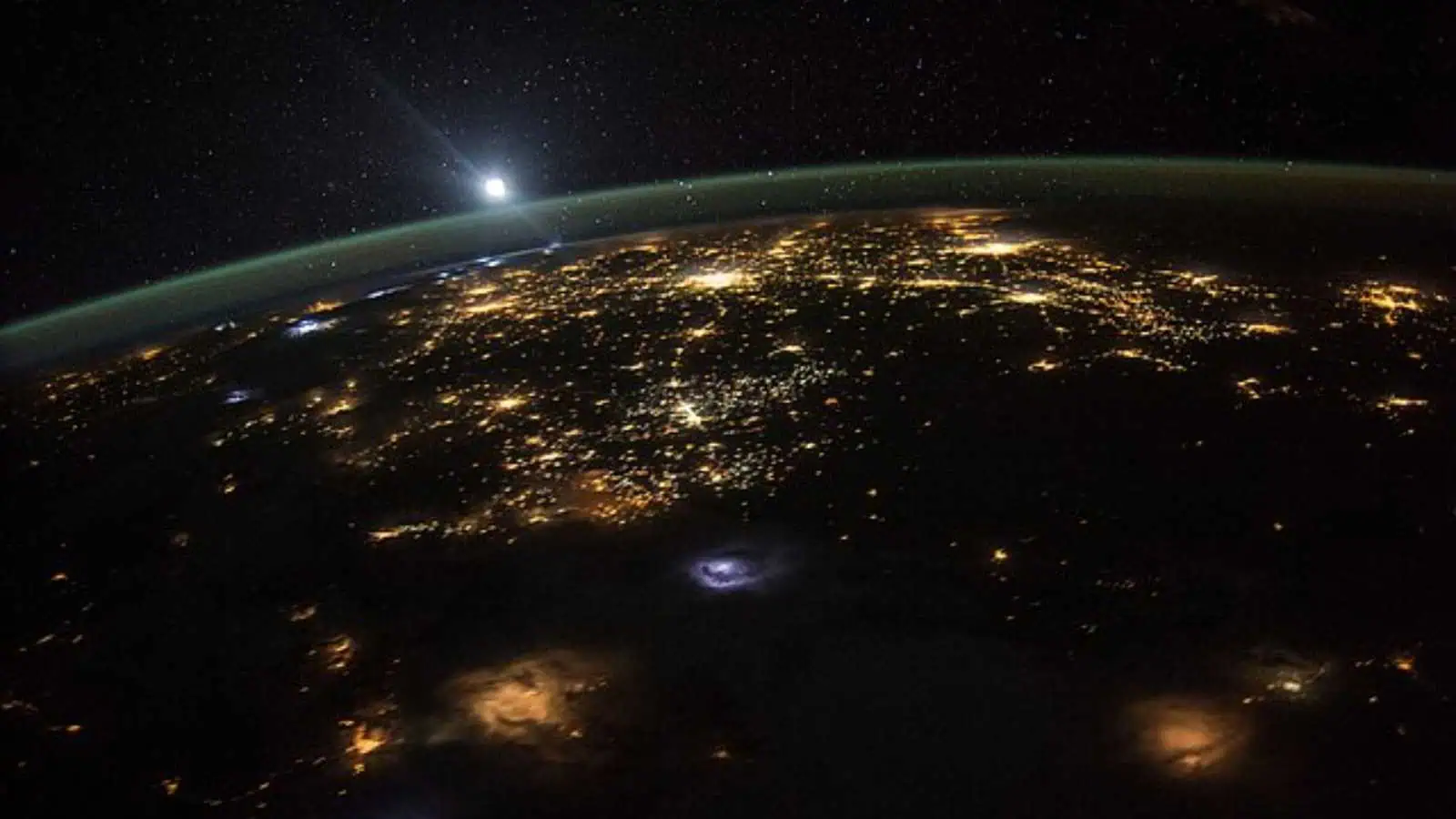
One theory suggests that the universe acts like a giant computer that processes information at the most fundamental level. If everything breaks down into bits of data—the basic units of information—it supports the idea that we’re part of a massive simulation running complex code. Every particle & interaction is computed. It’s a scary thought!
Disclaimer: This list is solely the author’s opinion based on research and publicly available information.
Like our content? Be sure to follow us.
Read More: