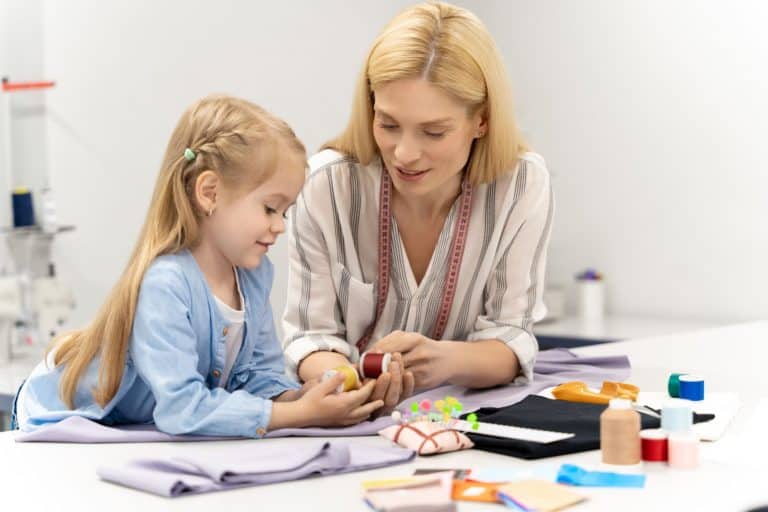

A few centuries ago, kids in classrooms did needlework samplers. They’d stitch their ways through linen stretched tight in wooden hoops as part of this rather slow & demanding hobby. It also taught them patience and precision. Let’s find out more about this lost hobby.
Featured Image Credit: Shutterstock.
Key takeaways
Here’s what you’ll learn about:
- What these samplers actually looked like
- Why teachers made everyone do them
- How they built patience & precision
- When & why they disappeared from schools
What the hobby was

Essentially, a sampler was a rectangle of linen covered with neat rows of letters & numbers. They sometimes had a stitched verse from the Bible. Many families framed theirs or kept them as proof that their kids could sew & read. While some were quite simple, others were practically works of art.
They weren’t a niche thing either, as girls in colonial America & across Europe stitched them at home and school. You’ll find examples from charity schools in England, along with fancy female academies in New England and even family parlors in the South.
The basic kit

The supply list was pretty consistent:
- Linen for the base, because it was sturdy
- Silk or wool thread, depending on what was available
- Steel needles, which were a luxury at first but became more common later
Unfortunately, there weren’t hobby stores, so families used what they had. The dye lots rarely matched perfectly, and this meant some samplers had slightly patchy colors. You can see them if you look closely.
How classes were structured

During sampler classes, kids started by stitching the alphabet in rows. They’d eventually master those & move on to borders and then to more complex designs like family trees or maps. In fact, some schools had set “levels” that were like moving from handwriting drills to writing short stories. A girl who finished her final sampler had usually shown off a range of stitches and spacing.
It was clearly quite the achievement for any girl who had managed to do so.
Why it trained patience

There was no way around it. Sampler work was slow. Girls had to count tiny threads in linen, and keep the stitches even, as well as redoing whole sections whenever they miscounted. A single band of alphabet letters could take hours. Since it was so time-consuming, girls often worked on their samplers for weeks, squeezing in stitches between chores & lessons.
Anytime they messed up, they had to carefully undo the fine thread so they didn’t tear the cloth. There’s no fast way to do that. It taught girls the art of waiting and being careful with their work, which are things we could probably all do with learning today.
Why it rewarded precision

Interestingly, the fabric itself forced precision because it was woven in a grid. Every cross-stitch depended on counting threads correctly, and being off by even one would cause your letters to tilt or your border to go crooked.
Likewise, decorative stitches like queen stitch or eyelets had to be placed just so. Failing to do so meant the pattern would collapse. As such, kids learned rather quickly that guessing didn’t work & they had to pay serious attention to it.
Boys making samplers

It didn’t happen often, but yes, boys stitched samplers too. However, unlike with girls where it was a hobby & a class, this only happened in places where stitching was part of general education for all children. It was common in schools for working-class or orphaned kids because those programs didn’t always separate activities by gender. Boys stitched right alongside girls.
Some families also had boys do small marking samplers at home to make sure they could sew initials into clothing or household linens. Those tended to be simpler & more practical than the decorative samplers from female academies. However, they served the same purpose to prove the child could sew letters accurately.
A timeline of samplers in the U.S.

The timeline for samplers went something like this:
- 1700s: Girls learned stitching at home & in church schools. Samplers helped them with reading and writing. They also learned sewing.
- Early 1800s: Female academies spread, especially in New England, and needlework became more elaborate & standardized.
- Late 1800s: Industrialization and changing curricula. New educational priorities pushed samplers out of schools, but some Southern schools held on longer. The practice disappeared almost entirely by the Civil War.
How and why the practice faded from everyday schooling

So what happened to samplers? It wasn’t one single reason. Schools started focusing more on academic subjects, so sewing shifted from a daily hobby to something done less at home. This decline worsened, especially as manufactured textiles became cheaper.
Around the 1830s, printed embroidery charts began appearing, imported directly from Berlin. This meant stitchers no longer had to work out designs on plain fabric. Instead, they could buy a ready-made grid, with each square showing a specific thread color.
The rise of women’s colleges also meant girls were studying math & science, instead of just stitching alphabets. By the early 1900s, samplers became more of a nostalgic craft than a standard lesson. It eventually disappeared entirely.
Sources: Please see here for a complete listing of all sources that were consulted in the preparation of this article.
Like our content? Be sure to follow us.

