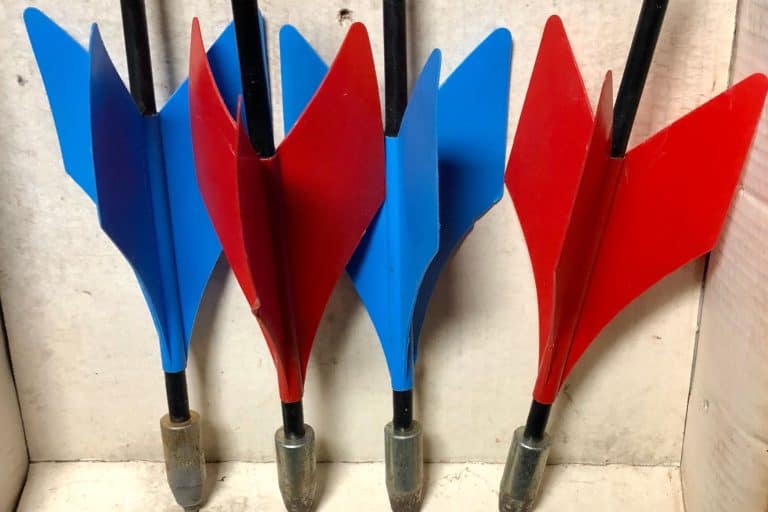

Backyard games usually involve frisbees & wiffle balls, along with other harmless stuff. But it was a different story in the 70s & 80s. Back then, there was a game known as “lawn darts,” which looked innocent until you realized it involved 12-inch darts tipped with metal spikes.
These things were sold as a “family activity.” However, rather than soft beanbags, kids threw sharp projectiles flying through the air. So what happened to them? How did they get banned? And why on Earth were they so popular to start with? Let’s find out.
Featured Image Credit: Shutterstock.
A game with serious bite

Lawn darts were sometimes known as Jarts. They were about a foot long, with heavy steel tips & plastic fins that allowed them to fly straight. The goal was simple with them. You just had to throw them underhand at a plastic ring sitting on the grass, which sounds easy enough.
However, the tips weren’t rubber. They weren’t soft. Instead, these lawn darts were literally designed to dig into the ground. Just imagine how bad they’d be if they got someone’s head instead of the ground. Ouch.
Why were they so dangerous?
There were two main reasons they were so dangerous. For starters, the design. A pound of weight behind a sharp steel point will go through skin & bone, relatively easily, sometimes even organs. These were hardly Nerf toys.
But one of the biggest issues was who played with them. While advertisers marketed the game as being for adults, kids always ended up near the target, which meant a mis-throw or even a second of distraction could be deadly.
Early warnings and limited rules

Thankfully, the danger didn’t go unnoticed. In 1970, the FDA ruled that these sharp-tipped darts were a mechanical hazard, but bizarrely, manufacturers could still keep them on shelves. They just had some specific rules about doing so. These included:
- Putting warning labels on every box
- Warning kids not to play with them
- Keeping them out of toy aisles
As you might be able to tell, the FDA didn’t exactly make things better. Sure, lawn darts were banned from toy stores, but they were still sold in sporting goods & department sections. Families kept buying them, until the death toll became too hard to ignore.
The alarming injury toll

The Consumer Product Safety Commission (CPSC) conducted research on lawn dart injuries between 1978 & 1986. And what did they find? Well, around 6,100 ER visits were directly linked to lawn darts. But that’s not all:
- 81% of victims were aged 15 or younger
- Around half of the victims were 10 or younger
As for the majority of injuries, they were where you’d expect, which were the head, face, eyes & ears. Another medical report broke it down further by discovering that:
- 54% of kids had head injuries
- 17% of them had eye injuries
- 11% had face injuries.
More than half of those cases needed hospitalization. Unfortunately, some of these cases ended in permanent blindness or brain damage. Around 4% of these were sadly fatal. Just a single toss could change your life.
Tragedy spurred action

It took until April 1987 for the biggest push for changes to come, and it came after the tragic death of seven-year-old Michelle Snow. She was playing in her yard when a neighborhood kid threw a lawn dart. The dart flew over the fence & landed in her skull with an estimated 23,000 psi of pressure. That’s strong enough to cut through concrete.
Michelle passed away three days later from her injuries. However, her dad, David Snow, refused to allow something similar to happen again. He started a campaign with the CPSC, demanding a real ban and insisting that the CPSC re‑check their injury data to understand the full scope of ER visits.
Sadly, around the same week that Michelle died, an 11-year-old girl in Tennessee was also hit by a lawn dart & fell into a coma. That pretty much ended the debate.
The final straw
After these deaths, it took the CPSC a little over a year to finally act. They banned the sale of all metal-tipped lawn darts in the U.S.A. from December 19, 1988. This follows the government’s attempts at warning labels & better packaging, even store restrictions.
None of it worked. The injuries just kept piling up, and parents like David Snow kept fighting until by late ’88, the darts were officially gone.
Canada follows suit
The U.S. ban received attention north of the border, too, as Canada banned metal-tipped lawn darts in July 1989. This was under the Hazardous Products Act. This Act prevented all sales of lawn darts, new or second-hand, and several other countries followed suit, too.
Aftermath & legacy

However, the ban wasn’t enough in some cases, as the CPSC actually had to remind some people to throw away old sets. Millions of people had them tucked away in garages. Of course, people still felt nostalgic about the game, but the data clearly proved that it wasn’t safe.
That’s not to say lawn darts are completely extinct. Nope, they still exist, but they’re not the same, as manufacturers swapped the sharp tips for blunt plastic or even weighted rubber. These don’t stick in the ground very well. But at least they don’t stick in skulls either.
Sources: Please see here for a complete listing of all sources that were consulted in the preparation of this article.
Like our content? Be sure to follow us.


