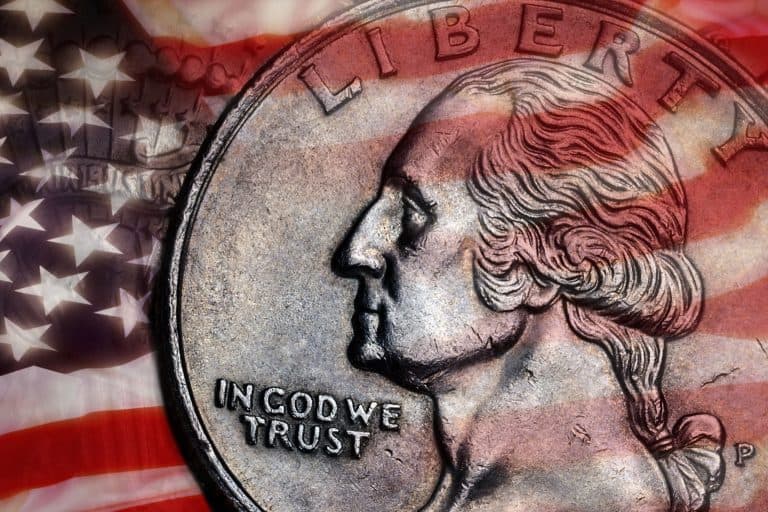

Have you ever stopped to think about the history behind the coins in your pocket? You can recognize presidents or familiar symbols, but did you know most coins feature meaningful symbols? In fact, many U.S. coins have historical and symbolic clues about the nation’s past and future. From patriotic allusions to simple symbols, coins are surprisingly rich in history and meaning.
Featured Image Credit: Shutterstock.
The 1916 Standing Liberty Quarter’s hidden star
On the 1916 Standing Liberty Quarter, the figure of Liberty holds a shield and an olive branch. A small star is embroidered in the folds of her dress, a tribute to America’s fundamental principles and her hope for liberty.
The olive branch and arrows on the Liberty Head Double Eagle
If you look very carefully on the Liberty Head Double Eagle, there is both an olive branch and a bundle of arrows in the eagle’s talons. The olive branch signifies peace and the arrows readiness for war.
The 1793 Chain Cent
On the 1793 Chain Cent, the chain displayed 13 links to represent the original 13 states. Although intended to symbolize unity, many saw the chain as a symbol of bondage or slavery, which was a major controversy at the time. The chain was quickly replaced with the wreath as the wreath was a more universally understood symbol of victory and concord among the states.
Hidden figures on the Texas Centennial Half Dollar
The reverse of the 1934 Texas Centennial Half Dollar features the winged goddess Victory grasping the Alamo and an olive branch. The tiny busts of Sam Houston and Stephen Austin are tucked away in the clouds above her. These two Texas leaders are memorialized by these nearly hidden figures.
The ‘Sower’ and the Walking Liberty Half Dollar
Weinman used the French “Sower” as an inspiration for the Walking Liberty Half Dollar. He gave it an American twist, depicting Liberty marching toward the new day. This coin’s design radiates hope and the country’s expansion.
The ‘In God We Trust’ Motto’s Civil War origins
The first time that “In God We Trust” appeared on a United States coin was during the Civil War. It was added to the 1864 Two-Cent Piece. The phrase was a way for the nation to look for strength and guidance in God during a time of turmoil. It has remained on U.S. coins ever since.
The Mercury Dime’s Winged Liberty
On Mercury Dime, Liberty is shown wearing a winged cap which symbolizes the freedom of thought. The fasces on the reverse implies that a union makes a country powerful. Each element embodies the ideals the United States aspired to impart to posterity.
The Union Shield on the Two-Cent Piece
The shield on the 1864 Two-Cent Piece is referred to as the Union Shield. It has 13 vertical stripes with a bar above them. The 13 stripes symbolize the original states, and the bar represents Congress. It is a nice symbol of national unity and secure government.
The 1795 Draped Bust Dollar’s symbolism

The Draped Bust Dollar of 1795 shows Liberty in a loose gown, reflecting moral virtue and simplicity. The small eagle on the reverse side symbolizes the new nation and its aspirations for the future.
The 1946 Roosevelt Dime’s Torch of freedom and sacrifice

On the 1946 Roosevelt Dime, the torch in the center represents the light of freedom. Encircling it are an olive branch and oak branch, which stand for peace and strength.
The 2025-W Proof Silver Eagle’s laser-engraved details
The mark, which is small and laser-engraved, on the 2025-W Proof Silver Eagle, provides for crisper detail and a more refined finish. This is a new addition for 2025, showing how the U.S. Mint is using technology to provide a precise coin that will last for years to come.
The 2024 Celia Cruz Quarter’s cultural representation
The Afro-Latina singer Celia Cruz is immortalized on the 2024 United States quarter. Her quarter, designed as part of the American Women Quarters Program, is a tribute to her vibrant spirit and music.
Sources: Please see here for a complete listing of all sources that were consulted in the preparation of this article.
Like our content? Be sure to follow us.


