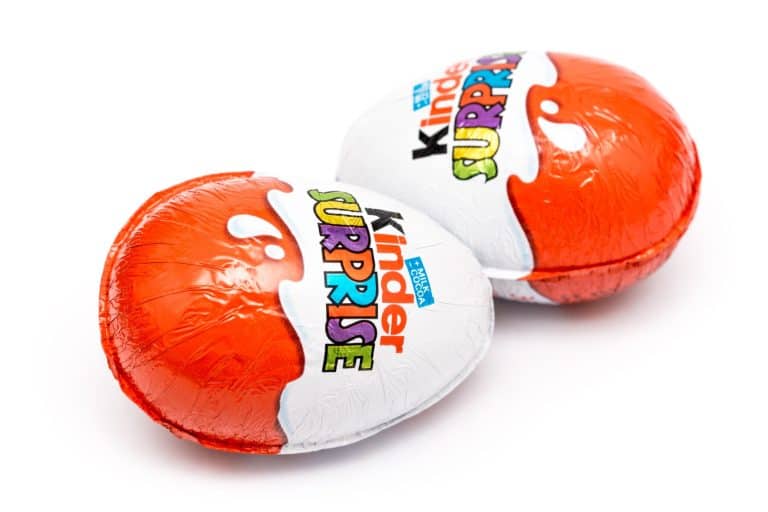

For most people outside the U.S., Kinder Surprise eggs are just another candy aisle favorite. They have chocolate on the outside & a toy inside. However, they’re completely illegal in America for two rather interesting reasons.
What are the reasons? What does this rule tell us about American food safety laws? Let’s look at the details.
Featured Image Credit: Shutterstock.
Key takeaways
You’ll learn about:
- The law banning Kinder Surprise eggs
- Why packaging matters so much in this case
- What happens if you actually try to bring them into the U.S.
- What this shows us about American food safety
The rule at the center

The ban on Kinder Surprise eggs is due to the Food, Drug, and Cosmetic Act (FD&C Act). Under section 21 U.S.C. § 342(d)(1), food is “adulterated” if it is a confectionery that has a non-nutritive object inside. There is a narrow exception. But this only applies if the FDA decides the item has a practical function & isn’t dangerous.
These exceptions include things like packaging materials or decorative elements that aren’t hazards.
Toys don’t make the cut.
The FD&C Act was passed in 1938 & helped to create the modern food safety system. Then, in 1966, Congress slightly adjusted the law through Public Law 89-477, allowing an adjustment for non-food items as long as they’re safe & are to help with the product in some way.
Every year, Customs and Border Protection (CBP) reports seizures, sometimes thousands at a time, of contraband food. This is at ports & mail centers, as well as airports. Anytime that they’re found, CBP confiscates & destroys these items, even when travelers bring them in as a treat.
Thankfully, you won’t be arrested for bringing them in, but you could be fined anywhere between $300 & $2,500.
“Embedded” versus “separate”
The word “embedded” is important when it comes to Kinder Surprise eggs. The FDA’s import policy, titled Import Alert 34-02, tells inspectors that they have to detain candy that has any non-food item built into it.
A toy that’s packaged next to the chocolate is completely fine & that’s why you’ll still find spin-off Kinder products in the U.S., like “Kinder Joy.” They’ll have the treat in one half, the toy in the other. In this case, the chocolate isn’t seen as adulterated.
Where the CPSC comes in

However, the truth is, it doesn’t really matter if the candy side somehow passed because there’s another group that stops the toys inside. It’s the Consumer Product Safety Commission (CPSC). Their small-parts regulation, 16 C.F.R. Part 1501, bans toys meant for kids under three that have pieces small enough to choke on.
This is mostly due to evidence from medical groups like the American Academy of Pediatrics. They have flagged food & toys with tiny parts as major choking hazards for young kids, with one 1999 study from JAMA finding that labels & warnings don’t always solve the problem.
Related safety benchmarks used by the FDA
The FDA also has general guidance on “foreign objects” in food. These rules cover things like shards of glass & metal, or any other items that could hurt someone if they swallowed. Of course, this rule isn’t written specifically for toys in candy. But it does show that anything hard or sharp enough to cause harm simply won’t pass.
Another law is the Poison Prevention Packaging Act from 1970, which came about because too many kids were getting into medicines & household chemicals. The law required packaging that was harder for children to open.
Don’t forget about the Fair Packaging & Labeling Act of 1966. Although it sounds dull, it makes sure that all packages list what’s inside & who made it. They also have to declare how much of it there is. And yes, it has to be in both metric & U.S. units, giving you clarity so that you’re not left guessing when you pick something up at the store.
What these rules say about U.S. safety laws

What’s really interesting here is what the rules show us about food safety in America. The laws here lean toward prevention. As long as there’s even a small chance something could hurt a child, the system doesn’t allow it to happen.
It also shows us how much authority the FDA has & how they can call food “adulterated” not just when it’s contaminated. Then there’s the CPSC, which has its own set of powers. Each agency has its own responsibilities, but they’re all connected by the same idea that when there’s a risk, act before it becomes bigger. Overlapping agencies help to create a double lock on anything that might slip through.
Whether it’s the federal food law or CPSC’s small-parts rule, one thing’s clear. The odds of seeing the original eggs on U.S. shelves are basically zero. You’ll have to save them as a vacation treat.
Sources: Please see here for a complete listing of all sources that were consulted in the preparation of this article.
Like our content? Be sure to follow us.
