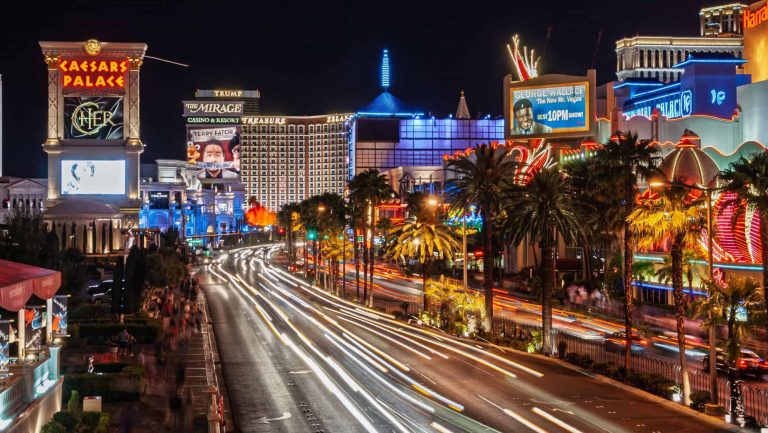

Las Vegas is famous for its glow, but there was a time when the lights went out. Yes, on a cool night in November 1973, many Vegas resorts turned off their neon lights, although not because the bulbs burned out. What happened & how did Las Vegas’s neon lights come back? Let’s find out.
Featured Image Credit: Shutterstock.
Key takeaways

You’ll learn about:
- How neon first made Vegas’s iconic look
- Why 1973 made managers dim the glow
- How long the blackout lasted & how the lights returned
- How resorts got around the rules
- How the lights changed after the crisis
How neon became the city’s signature

Sure, Las Vegas didn’t invent neon. But it became part of the city’s DNA. By the 1950s, resorts competed to out-flash each other, bending glass into ten-story letters & wiring miles of tubing. Drivers coming into town could see the glow from way down the highway. All this glitz was necessary because, without those signs, casinos looked like plain buildings.
The request to dim
The fall of 1973 was a difficult time for America, as it hit an energy wall. The Arabian oil embargo led to less fuel & higher costs, as well as a whole lot of pressure to cut back. Nevada’s power officials called on businesses to trim the excess.
In Vegas, the flashing cowboys and giant marquees all counted as excess. And so did the casino rooftops that used electricity all night. Most resorts didn’t argue with these rules and simply started planning how to go dark.
What “ran out of neon” really meant

Nobody ran out of glass tubes or neon gas. Instead, what Vegas “ran out of” was permission, as signs were considered non-essential & were cut first. But some people still say the city “ran out,” even though they’re really talking about the night the glow wasn’t allowed to shine. It was a rules issue more than a supply problem. Still, the effect was the same in that there were no lights.
The signs go dark

It was mid-November when the Strip blinked off, although it was a voluntary switch-off more than a blackout. Hotels kept slot machines running inside. But outside, the iconic towering letters & animated bulbs were switched off, which made things rather eerie for the tourists driving in. The city famous for light suddenly looked unfinished.
The impact was different in each area. Primarily, it was two places that mattered most, which were the Strip itself & downtown’s Fremont Street. Those areas had the biggest, brightest signs, like the cowboy at the Pioneer Club and the giant marquees above resorts. The heart of Vegas looked empty once they shut down.
The shutoff clock

Most people thought the shut-off would be short. It wasn’t. The rules dragged on for more than a year, changing in stages, with the state starting to ease up during the spring. In April 1974, casinos were allowed to light up on Friday & Saturday nights only. It wasn’t a full restoration. However, it gave hotels a way to bring back some glow without ignoring orders.
Then, in September, regulators expanded the window again. Resorts could now run their lights about 5½ hours each night, so they could time the big switch-on to match peak foot traffic.
The blackout ended in January 1975 when the Strip’s night sky finally returned.
Workarounds & one odd exception

During the “blackout,” most places just shut off and waited. But a few got clever. The Las Vegas Hilton was one of them, as it used a portable generator to keep part of its sign going at night. And to run that generator? A horse walking in circles. Yes, really.
Since the hotel wasn’t using the power grid, it technically wasn’t breaking any rules, although it didn’t light up the whole property. The generator only worked on a section. However, it stood out because the Strip was otherwise dark and showed how far some businesses were willing to go just to keep even a sliver of their image alive.
Beyond the Strip

The switch-off also affected many smaller areas around town. Billboard companies dimmed most of their lighting & cut around three-quarters of their usual output, while hotels made heating adjustments indoors to save fuel. This meant guests sometimes dealt with cooler rooms.
On top of this, city leaders asked residents to use less power during the early evening hours because that was when the grid got hit the hardest. Resort operators were told to aim for a 35% reduction in overall energy use. That was quite a big ask for places that ran around the clock.
After the crisis

Decades later, the Vegas lights changed entirely. Casinos went bigger and brighter using LEDs & video screens, as they were cheaper to run and easier to program. They also didn’t need glassblowers bending tubes all day. By the ’90s, a lot of new resorts scrapped traditional neon entirely.
But what happened to the classic signs? Well, they didn’t all end up in the trash, as preservation groups rescued & stored many of them. A few pieces of these survived in museums, and others sat in yards until collectors hauled them off. You can still see original Vegas signs today, even though the Strip moved on.
Sources: Please see here for a complete listing of all sources that were consulted in the preparation of this article.
Like our content? Be sure to follow us.

