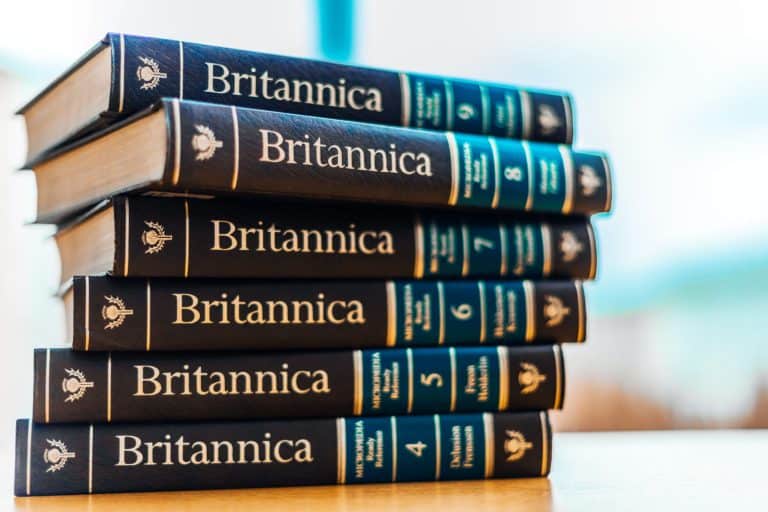

A set of encyclopedias was once the pride & joy of every living room. Many families spent a lot of money on those rows of thick books, which weren’t simply for homework. They were also a status symbol.
Why did families buy them? And what changed? Let’s have a look.
Featured Image Credit: Shutterstock.
What you’ll find out

You’ll learn about:
- The strange way encyclopedias were sold & paid for
- Why these books gave people so much pride
- How technology knocked them off the shelf
- What they’ve been replaced with & the consequences of this
What a household set meant

Beyond mere reference books, encyclopedias were practically pieces of furniture. Many families kept them in living rooms & studies, lined up neatly in alphabetical order. A full set was around 20–30 hefty volumes. They had indexes that made looking up information quicker…or as quick as it could be, in the days before the internet.
Kids used them for reports & parents used them to settle debates. Sometimes people would just flick through them out of curiosity.
Lots of libraries used them, too. The staff would use them constantly because they delivered reliable & short entries, while the set’s designs made them easy to flip through. That was the whole point. They were built for quick answers.
Later, when CD-ROMs & online versions came out, the basic goal didn’t change. People still wanted short and reliable overviews, it’s just the way they got them changed. Goodbye paper, hello screens.
How people bought them

However, buying an encyclopedia set wasn’t as easy as grabbing a book at the mall. For most of the 20th century, companies like Encyclopaedia Britannica & World Book sold them door-to-door. This would involve a salesperson sitting down in your living room & showing you sample volumes. They’d then hand over a contract.
But these sets weren’t cheap. Far from it. They were often so pricey that families paid for them in installments, and they’d get a couple of volumes delivered first. The rest came after more payments.
Falling behind on your payments meant having to deal with some rather pushy collection tactics. Really, the book companies treated them like financing a piece of furniture or an appliance. You wouldn’t expect to get away with missed payments on those, would you?
Why the books carried real pride

Part of the appeal of having encyclopedias was rather simple. Having them on display sent a message that the household cared about learning & they had invested in it. Sociologists call this “cultural capital.” Essentially, books in the home show a family values education, and studies show that kids in book-filled houses tend to do better in school.
But there was also something about the look of these sets that was so nice. Having a polished row of matching spines made a room look more studious, something that wasn’t lost on parents. They wanted visitors to notice. They didn’t tuck these books away in a closet.
What changed (and when)

The encyclopedia set’s fall from grace happened rather quickly. It went something like this:
- Early 1990s: Microsoft launched Encarta on CD-ROM, meaning that families could get multimedia encyclopedias on their computers for a fraction of the cost of a printed set.
- Mid-1990s: Encyclopaedia Britannica’s print sales nosedive.
- Mid-to-late 1990s: Encyclopaedia Britannica put its own version online & libraries started moving towards digital products.
- 2005: A Nature study found that Wikipedia & Britannica had similar error rates, giving online encyclopedias a credibility boost.
- 2012: Britannica officially stopped printing new multi-volume sets and went fully digital.
What that meant for homes, schools & libraries

For families, the bookshelf stopped being a centerpiece of conversations & parents stopped buying new sets. That “show it off” factor disappeared because everyone knew the internet was the place to look, rather than a physical book that was probably outdated now, anyway. Most old encyclopedias either began collecting dust or their owners donated them.
Libraries followed suit by moving money toward electronic databases & online subscriptions, rather than giant reference shelves. Teachers encouraged students to use digital sources. As such, students began learning how to type keywords & click links. They learned to go from one article to another.
These days, encyclopedias haven’t entirely vanished, but have simply changed form. Britannica publishes a digital-only encyclopedia that schools & libraries can still purchase online access to. Wikipedia is also an online encyclopedia. And it’s free.
The big difference is that updates happen constantly, not once every few years when a new edition is printed.
While you might not see those huge sets on a shelf anymore, the idea of a curated & fact-checked reference work is still very much alive. The world’s knowledge is more accessible than it ever was.
Sources: Please see here for a complete listing of all sources that were consulted in the preparation of this article.
Like our content? Be sure to follow us.
