

If you’re still someone that carries around a good old fashioned paper notebook, your brain is probably wired differently.
Deeper conceptual processing

It’s possible that writing by hand nudges people towards processing information rather than simply transcribing it.
A popular study from 2014 found that students who took notes by hand performed better on conceptual questions than students who took notes on laptops.
Pam Mueller and Daniel Oppenheimer argued that taking notes on a laptop led students to transcribe lectures verbatim while students with pen and paper processed the information and put it into their own words.
Better spatial cues
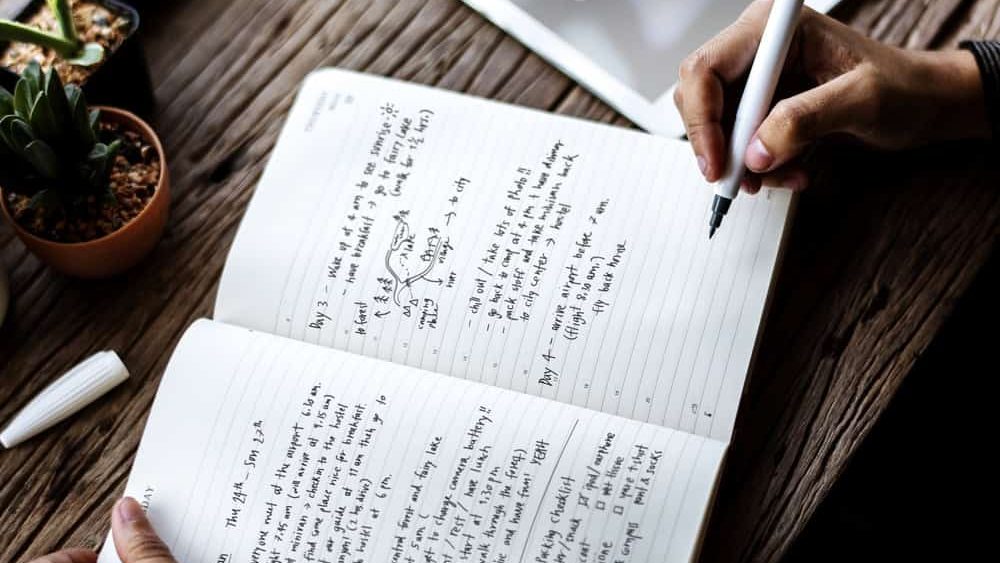
When you take notes in a physical notebook, your notes always stay in the same place on the page. You’ll remember that a key detail was at the bottom of the left page, scribbled next to your doodle or perhaps underneath the heading you underlined.
These small details can provide your brain with additional cues when you try to recall information later.
Mental friction
We can type much faster than we can write something down. Handwriting with a pen and paper is slower.
But slowing yourself down can actually be a good thing. Because you can’t write as fast as someone can talk, you need to listen carefully and decide what you want to write down. This relates to the concept of “desirable difficulties.” Sometimes making something more difficult for your brain to learn can help you better recall it later (even if it feels more challenging at the time).
That being said, this doesn’t mean that handwriting your notes is always the best way. But because it is slower than typing, you need to pick out key points, summarize what you’re hearing, and process the information as you write.
It’s not about using a pen that provides friction. It’s about paying attention.
Paper and memory
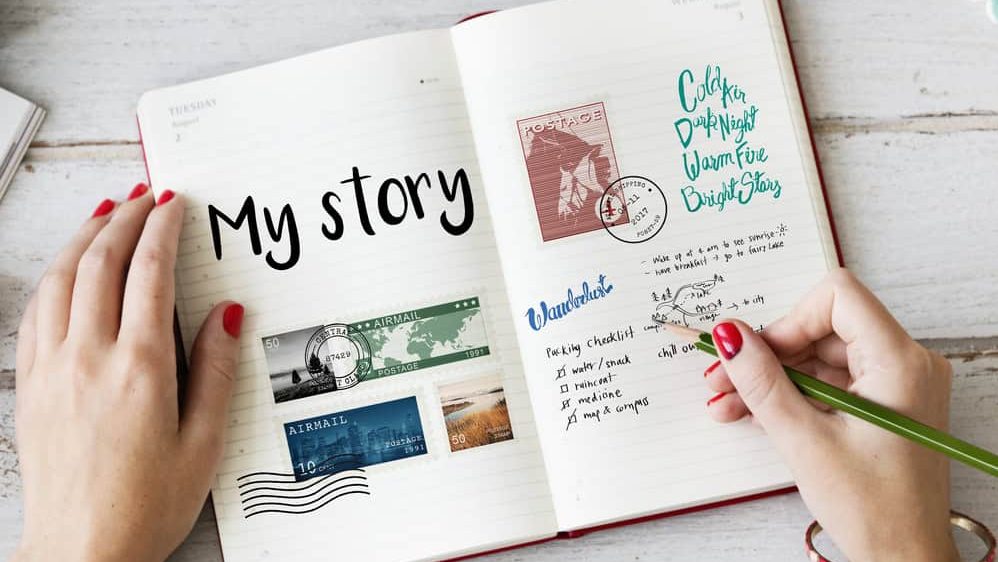
Your notebook is more than words on a page.
It is your handwriting, where the writing falls on the page, crossed-out sentences, arrows and doodles, ink blots, and sometimes even the order in which items were added. All these features build up a physical context around the information.
Of course, this doesn’t mean your notebook can encode every detail about an experience. But it can provide your memories with more physical context than a sterile digital document.
Better processing of your emotions

Writing about your feelings can help you process them. Handwriting allows you to easily do this.
Studies on “affect labeling,” or describing your emotions, have shown that merely naming your emotion can decrease activity in your amygdala along with other areas in the brain that process fear and emotions.
Studies on expressive writing have shown similar findings. One study done in 2026 showed that certain forms of expressive writing were associated with increased emotion regulation as well as decreased heart rate.
Fewer distractions

Notebooks are great because you aren’t going to be distracted by your phone or computer. If you take notes digitally you are prone to distractions such as messages, social media, email, websites, and other apps.
Paper eliminates most of these distractions. You will find yourself better able to focus on one task at a time, whether that be studying or brainstorming.
Complex sensorimotor activity

Handwriting seems like a simple task, but there’s actually a lot going on.
Your eyes are tracking the pen’s movements as your hand guides it across the paper. Your brain is also regulating pressure, direction, spacing, and shape of the letters.
Researchers who did a 2024 study using high-density EEG found handwriting created more neural connections between different brain regions than typing did. This study included 36 young adults and found variations in their brain activity in areas associated with motor movements and visual processing.
The researchers, therefore, hypothesized that writing by hand may allow the brain to be engaged in different ways by linking the visuals of the letters with the motor actions required to write them.
To put it simply, when you pick up a pen to write, your eyes, hands, and brain are all engaged in a cooperative process.
Visual thinking takes flight

A blank page doesn’t require you to write left-to-right, top-to-bottom. You can draw an arrow from one idea to another, circle a key word, jot notes in the margin, sketch something quickly, or put two related ideas side-by-side.
Paper is conducive to sketching out thoughts and ideas because it allows your thoughts to unfold outside of your head. Essentially, some researchers call this “external representational play,” meaning you’re using something beyond your own mind, such as pen and paper, to give shape to your ideas.
Instead of forcing your ideas to fit into a list of sentences, a notebook page can become a visual representation of your ideas.
Writing your goal down helps you commit to it

Putting your aspirations on paper can really help make them feel more solid, though the evidence behind this is a bit trickier than the “scribble it down and success will follow” idea.
Psychologist Gail Matthews conducted an experiment linking written goals to commitment, taking action and holding yourself accountable. Matthews found that writing your goals down can be an effective tool if you include it as part of the goal-setting process.
Keep in mind that Matthews was studying written goals. She was not studying if handwriting is better than typing. Plus there is no strong evidence that physically writing your goal makes your brain’s “reticular activating system” automatically highlight that goal as something you want to prioritize.
A more sound theory is that writing your goal down makes you state your goals in concrete terms instead of leaving them as an abstract notion in your head.
Richer motor encoding

Writing a word by hand involves more than just forming letters. It also requires your hand to trace a unique series of motions.
Every letter contains variations in direction, velocity, spacing, and pressure. Compared to typing, this process bombards your brain with extra data.
Sources: Please see here for a complete listing of all sources that were consulted in the preparation of this article.
Like our content? Be sure to follow us.
Psychologists say people with these 10 traits are surprisingly rare

There are some traits that we all have, but a lot of psychologists are interested in the people who lean unusually far towards one end of these trait scales.
Psychologists say people with these 10 traits are surprisingly rare

